
History of Kenwood United Methodist Church
Kenwood UMC was built in the 1890’s in the Queen Anne style of architecture, in Elmont, located in Hanover County, Virginia. Elmont is a small village along Elmont Road at Cobbs Road, just east of the old Richmond, Fredericksburg & Potomac Railway (RF&P) tracks, now owned by CSX.
Kenwood United Methodist Church, the boarded-up Cobb Store, and the old Elmont School building, now a private residence, are the only real landmarks left. Elmont is rich in history, and Kenwood has played a significant part in that history.
Although renovations and remodeling have somewhat changed the exterior of the church, the love for Jesus Christ remains rich within its historic walls. But to get a real sense of our history, we need to share some history of the surrounding community.
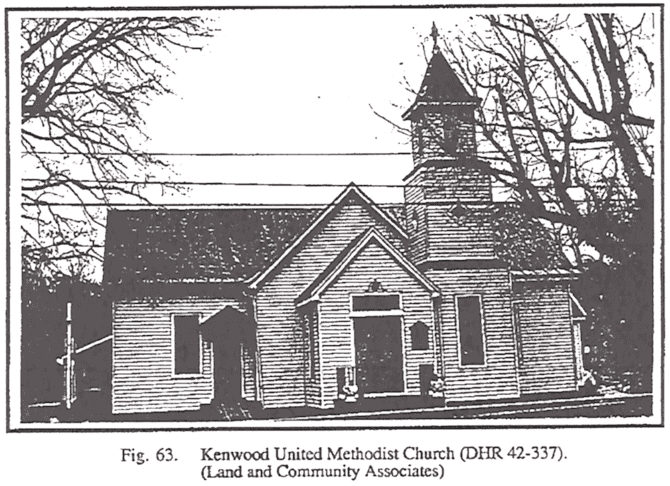
Photo of Kenwood Church circa 1960s
Addie S Crawford, Founder (1853 - 1942)
Mrs. Addie S. Crawford was the founder of Kenwood UM Church.
According to the Herald-Progress, “She was the daughter of a Methodist minister; naturally, she was active in the building of this church. If she could come back today and see the lovely stained glass windows, it would be a real surprise.” *
On Sunday, January 19, 1936, the church rededicated the church bell, which had undergone repairs. According to the Herald-Progress, the bell tower and bell were made possible through the efforts and gifts of Mrs. Stover, who was the mother of Mrs. Addie S. Crawford.**
On the 100th anniversary of her birthday, the church held a “Founder’s Day” Program in December of 1953.***
*Herald-Progress, Volume 107, Number 39, 30 April 1986.
**”Prof Tarry Speaks at Kenwood Sunday.” Herald-Progress, Volume 56, Number 10, 16 January 1936.
***”Kenwood Arranges Founder’s Day Program in December.” Herald-Progress, Volume 70, Number 52, 12 November 1953
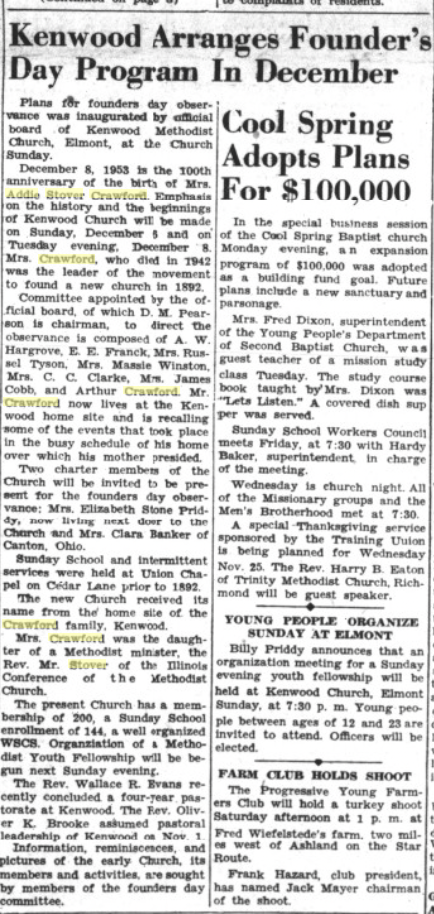
Herald-Progress, November 12, 1953
Methodists in Hanover County
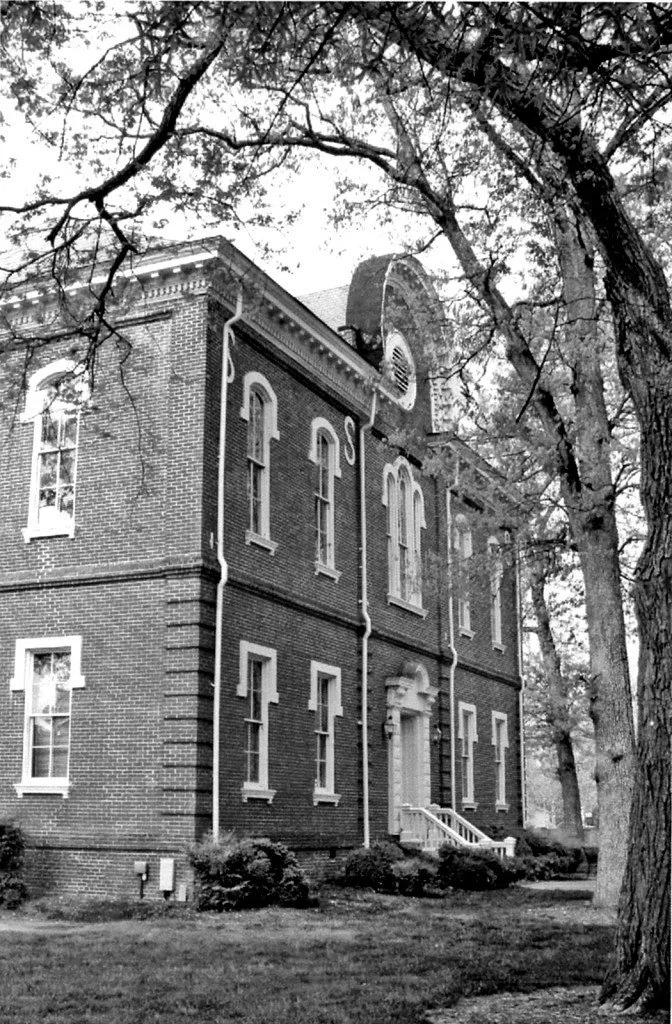
The old Wash-Frank Hall on the campus of Randolph-Macon College
The Methodist Church holds an important place in both the religious and educational history of Hanover County. The relocation of Randolph-Macon College from Boydton, Mecklenburg County, to Ashland in 1868, gave a special impetus to the growth of the Methodist population in Hanover County.
The college continues to be known as the oldest, Methodist-affiliated college in operation in the United States.
Several Methodist churches were established during the late eighteenth and early nineteenth centuries in Hanover County. One of these was Kenwood United Methodist Church, built in the 1890’s.
Kenwood UMC continues to stay very active with the community, including Randolph-Macon College, and is the only church still remaining in the area known as the village of Elmont.
Village of Elmont
Like many Hanover villages, the village of Elmont existed during the Civil War when J.E.B. Stuart’s men camped here as they were beginning their famous “Ride Around McClellan” during the1862 Peninsula Campaign. However, the area was known then as Kilby’s Station. Most construction ceased in the area with the outbreak of the Civil War. When the war ended, building activity resumed, but labor became more expensive.
During this time, many of the larger family plantations prominent in the early nineteenth century were subdivided into smaller farms. Family divisions also helped to create a tapestry of smaller farms.
During the 1880’s, the RF&P and the Ashland Streetcar service played a major role in the development of Ashland and the surrounding villages, including Elmont. New development could be found in the places where the train or streetcar stopped. The train stopped in Gwathmey, Elmont, and Kenwood, while the streetcar stopped in Gwathmey, Elmont, Cedar Lane, and Holly Hill.
Small clusters of homes began to be developed because of the transportation resources and their proximity to Richmond. Many homes were built in styles typical of the times, such as the Helen Cobb house, the Tyson house, the Kenwood House, and the Franck House on Cedar Lane. The owners of these homes were all members at one time or another, and generations of those families still hold deep roots within our church.
Traces of the old streetcar line survive, and it is particularly well preserved in the Elmont and Gwathmey areas, where power lines follow the same route. As settlements matured, stores most often were located at the crossroads or in these small villages.
When mail delivery began, post offices often were located in these general stores. In Elmont, you can still find residents who fondly remember walking to Cobb’s Store near the railroad tracks. The shell of the store still stands today, renovated, but not inhabited.
In rural areas such as Hanover County, these isolated “village” settlements made travel for recreation difficult, so social activities tended to center around the church. Kenwood UMC was, and still is, one such church. In addition to countless baptisms, weddings, and funerals, Kenwood UMC has been the epicenter for many social activities centered around the Elmont village community.
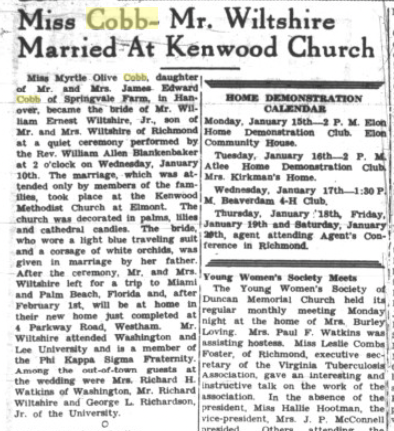
Herald-Progress, January 11, 1940
Kenwood Cemetery
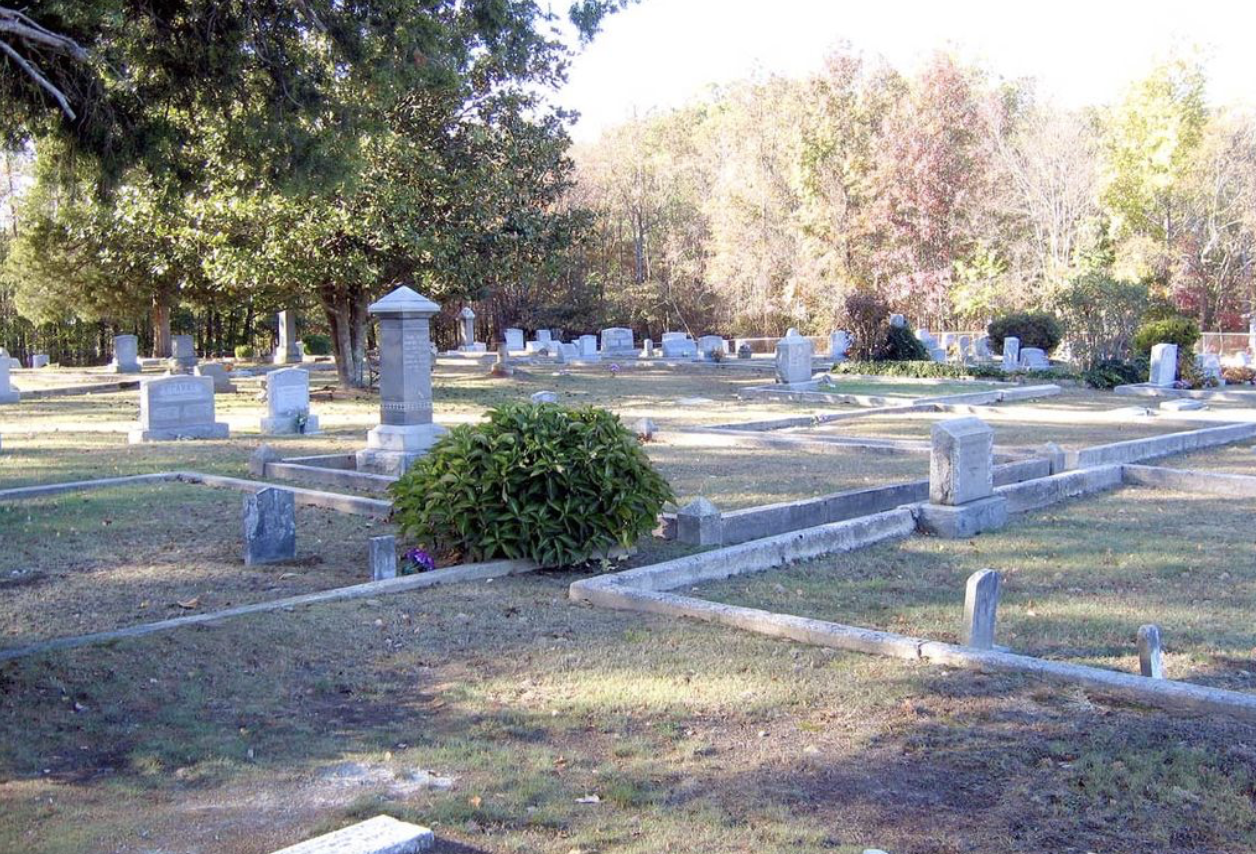
It was tradition in the early days, to own a family cemetery. But as the larger plantations broke down into smaller farms, families found them difficult to maintain. Cemeteries reflect traditional values, religious tenets, economic and social status, legal regulations, and even the natural environment. Religious institutions and their artifacts are known to be the most conservative aspect of a culture.
In Hanover, as elsewhere, it is often the cemetery that survives when all other traces of a plantation, farmstead, church, or village have long vanished. The tradition of family cemeteries was passed to community churches. Work on the Kenwood UMC Cemetery began in 1907 with the purchase of a parcel of land, several years earlier, located on what is known today as Kenwood Church Road. Gravesites in those days sold for 50 cents!
Today, because of the generosity of Kenwood UMC members, Kenwood Cemetery can be proud of the history that lies within its grounds.
Elmont School
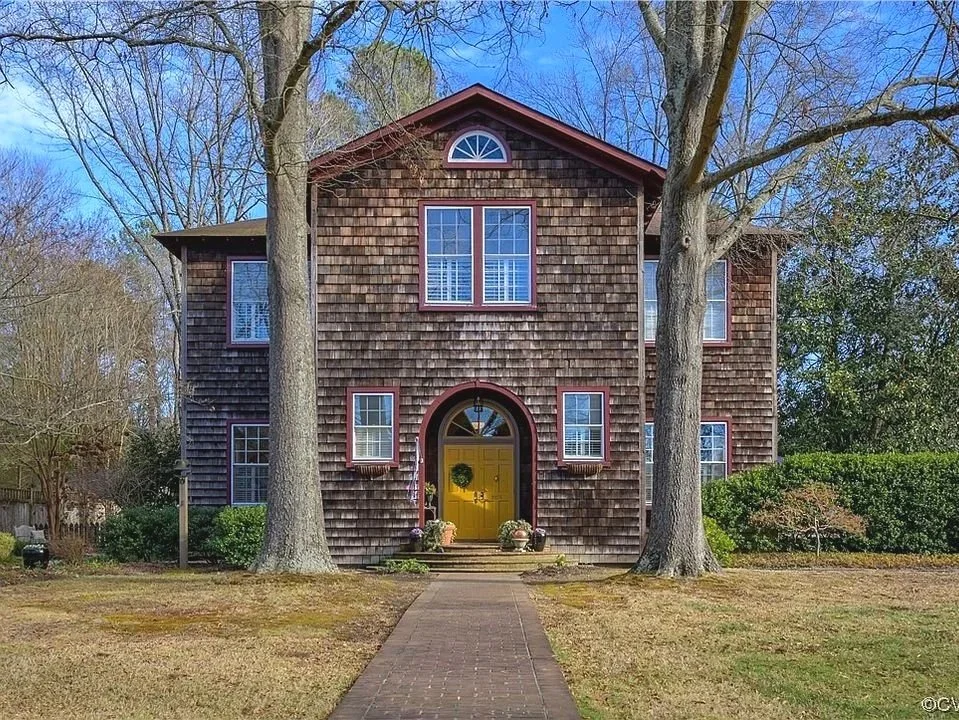
One of the remaining community buildings, the Elmont School built in 1911, still stands and was renovated by Greg and Cathy Daugherty. The school, with four classrooms, closed in the early 1960s when Elmont Elementary School was built.
The old school provided education to the children of Elmont Village, some of whom were members of Kenwood UMC. One such church member was Jim Cobb, who was a retired, longtime Patrick Henry football coach who lived next to the Kenwood United Methodist cemetery.
Memories of Kenwood Church
Many of those old traditions continue today, into the twenty-first century, with many long-time members sharing stories as they recall Kenwood’s rich history. Richard Thurston is quoted as saying he once asked his mother; how long had he been going to Kenwood UMC. To which his mother replied, “before you were born”. Thus, exemplifying the tradition of so many families and their commitment to Kenwood. Richard shares that his mother started going to Kenwood when she was 8 years old. Richard was born in 1940. The Thurston family can trace their attendance back to Richard’s grandfather. You do the math!
And such is the history of Kenwood, with many families tracing their attendance back to the founding builders in the 1890’s. Several families, such as the Priddys, the Cobbs, the Wrights, and the Tysons, to name a few, played a significant role in the establishment of Kenwood Methodist Church. Kenwood has had many generations of families that were, and continue to be, a vital part of Kenwood UMC. Names change, but they are still family. Some active families from the past are the Cobb’s, the Loving’s, the Tysons, the Hargrove’s, the Turners, the Dishman-Edwards group, the Hale family, the Swingle family, the Toms family, the Hobson family, the Buchanon’s, the Priddy’s and the Blunt’s.
Nancy Chappell remembers how “all the kids used to meet at Cobb’s Store, over by the railroad tracks. Byrd Turner’s dad was the Postmaster.” Back then the post office was usually in the general store as history tells us, so it was with the Elmont Post Office, located in Cobb’s Store.
Nancy Chappell married E. Byrd Turner, Jr. They had two children, Ed and Lisa. And as she shared, although no longer together, she and Byrd continue to share fond memories of Kenwood and the Elmont community. Members of her family also attended Kenwood over the years, Ed, Lisa, Julie & Barry (BJ’s children). Some went away and settled elsewhere, some still attend Kenwood.
As a member so eloquently wrote: “The church is not only a place to learn about God, Jesus and the Bible; it is also a good place to meet people of the Elmont area. It is good to be part of church in your neighborhood.”
“In the 1940s, Kenwood UMC consisted of one building. There was no running water and two outhouses located outside. The church had a lot of activities from meals to lawn parties and games. Many families walked to church because they had no cars. Many of the pastors came from Randolph-Macon College, which was begun by the Methodists. The church was heated by coal stoves. Men would come Saturday night or early Sunday morning and start fires in the three stoves in the sanctuary and one in the classrooms. When the church needed money, someone would always come forward with a little, to help pay a bill.
The Turner family were the treasurers for years and years and years. Barbara Jean’s grandmother, Mrs. Mills has a plaque on the front wall, her mother has a plaque on the side wall—one of the windows. Barbara Jean Johnson has been treasurer for years.
When I went to the old Elmont school, there were six in my class and we had three grades in one room. We all had the same teacher, Mrs. White. She taught my mother, my father, myself and my son, all in the first grade. When I was younger, the church had no air conditioner and we had to keep the windows open. When a train went by, the pastor would stop until it passed. My mother taught junior class for over 50 years. I worked with the youth and helped maintain the outside for years and served on the board of the church.”